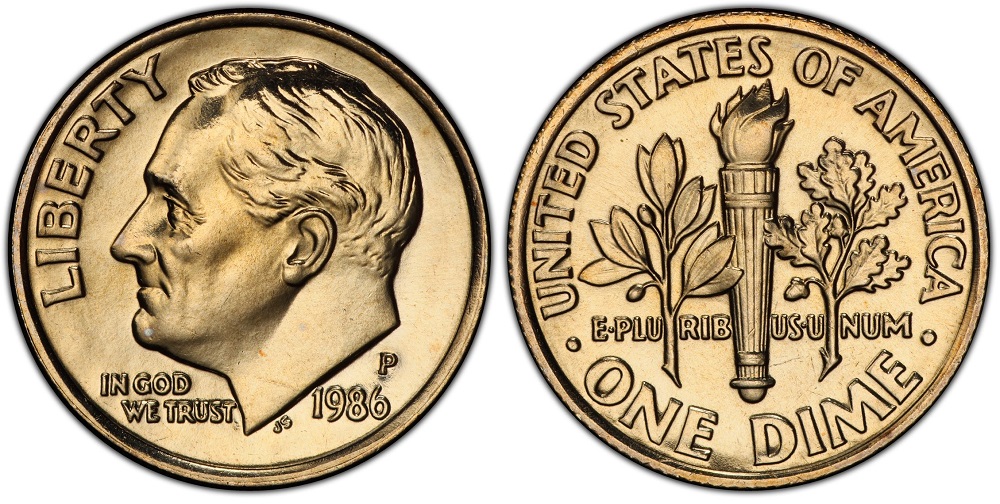
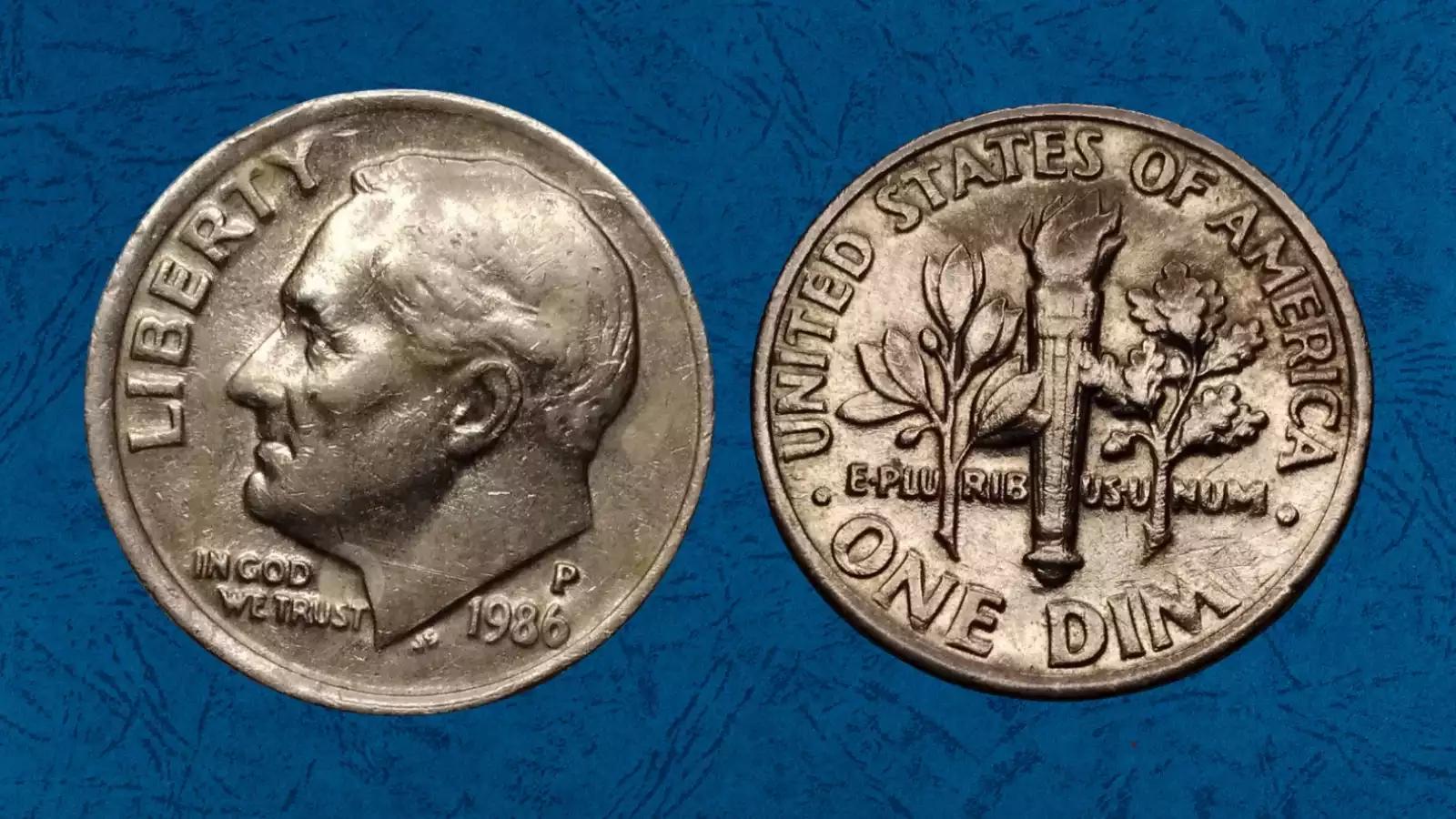
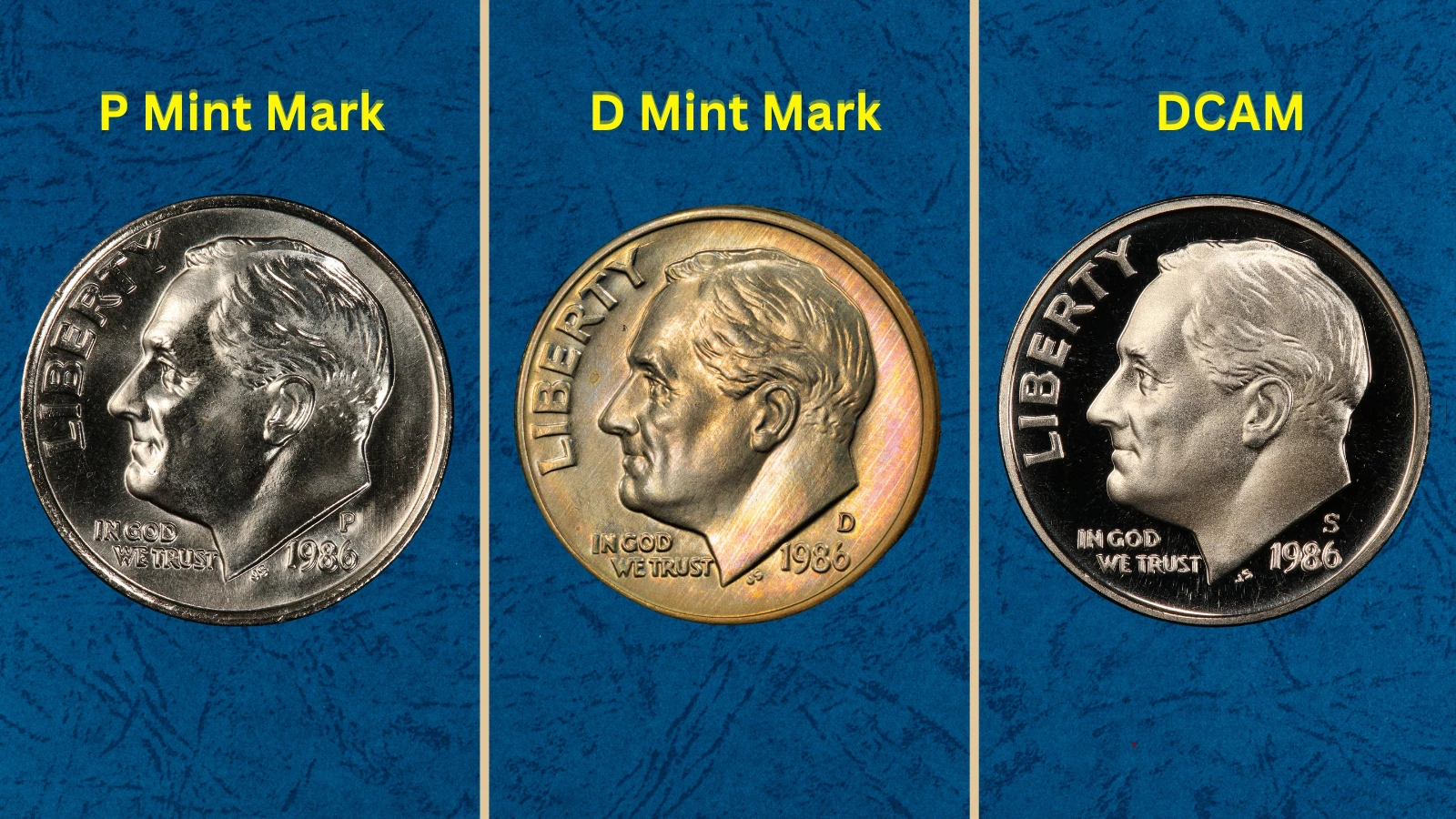
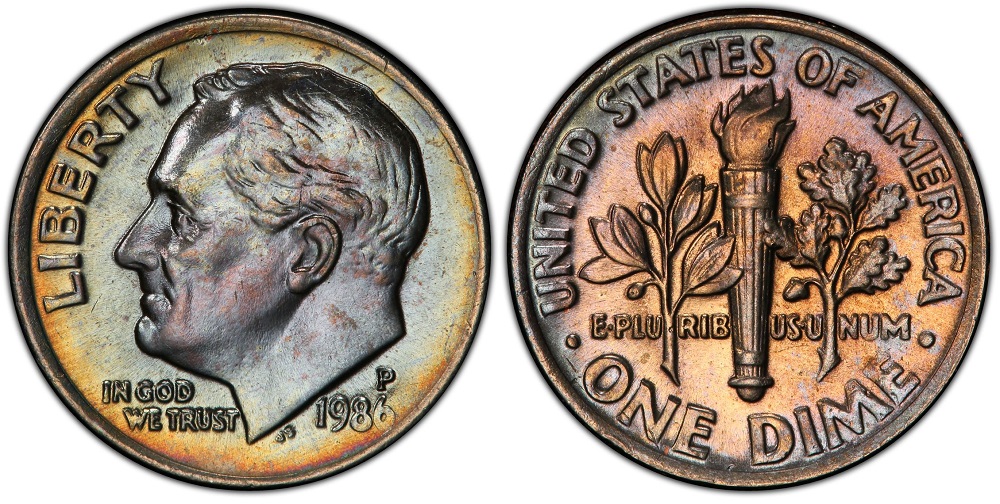
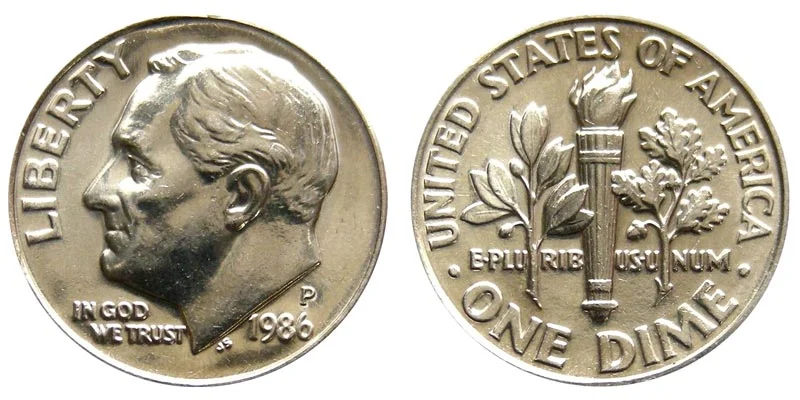
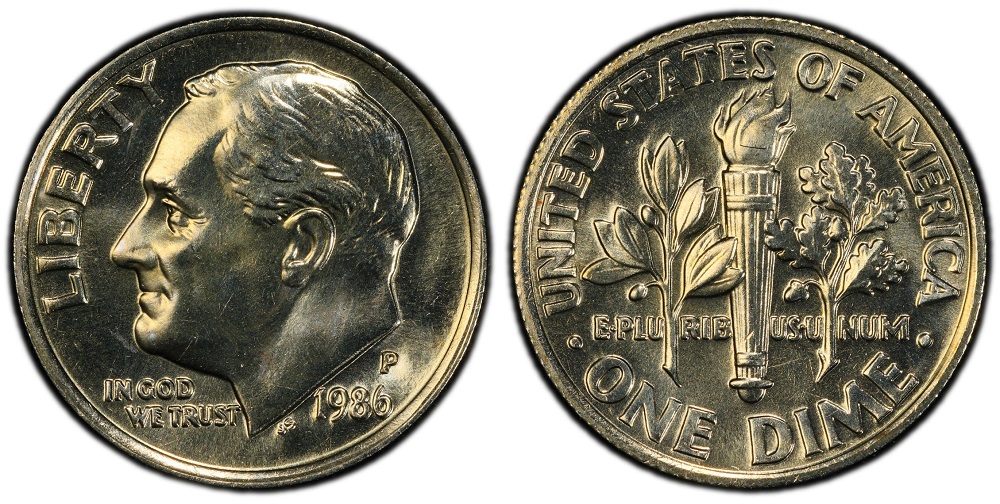
1986-P Roosevelt dime obverse and reverse showing the P mint mark above the date

The 1986 Roosevelt Dime Value Guide

A 1986-P MS-67 Full Bands example sold for $1,998 at Heritage Auctions in December 2015 — yet most 1986 dimes pulled from pocket change are worth just 10 cents. Over 1.1 billion were struck across Philadelphia and Denver, making strike quality and the coveted Full Bands designation the real dividing line between face value and four-figure territory.

★★★★★ 4.8/5 based on 1,347 collector ratings
Check My 1986 Dime Value →
$1,998 All-time auction record
1986-P MS67FB (Heritage, 2015)
1.16B Total 1986 dimes struck
across all three mints
FB Full Bands designation
the #1 value multiplier
3 Mint marks to check
P · D · S (proof only)

Free 1986 Dime Value Calculator

Select your coin's mint mark, condition, and any errors below to get an instant estimate.

Step 1 — Mint Mark
Step 2 — Condition
Step 3 — Errors / Special Designations (check all that apply)

If you're not yet sure about your coin's mint mark, condition, or possible errors, there's a 1986 Dime Coin Value Checker free tool that lets you upload photos of your coin and get an AI-assisted identification before you use this calculator.

Describe Your 1986 Dime for a Detailed Assessment

Not sure what to look for? Describe what you see in plain language — our analyzer will highlight key value factors.

Mention these things if you can

  • Mint mark letter (P, D, or S)
  • Overall shine and luster
  • Torch band appearance
  • Any doubling on lettering or date
  • Signs of wear or circulation

Also helpful

  • Off-center or misaligned design
  • Unusual edge (smooth instead of reeded)
  • Color abnormalities
  • Any visible toning or spotting
  • Presence of a PCGS/NGC holder

Skipped the calculator?

It takes less than 30 seconds — just pick your mint mark, condition, and any errors for an instant value estimate.

Get My Value →

1986-P Full Bands Self-Checker

The Full Bands designation is the single biggest value driver for 1986 Roosevelt dimes. Use this checklist to see if your coin might qualify.

Side-by-side comparison of a standard 1986 dime torch bands versus Full Bands (FB) example showing complete band separation

🔴 Standard Strike (Very Common)

  • Horizontal torch bands touch or run together at one or more points
  • Die flow lines cross through the band separations
  • Bands appear weak, mushy, or incompletely formed
  • Value: $0.10 – $150 depending on grade
— vs —

🟢 Full Bands Strike (Very Rare on 1986-P)

  • Every horizontal torch band shows complete, unbroken separation
  • No marks, die lines, or weak areas crossing the bands
  • Torch detail is crisp and three-dimensional under magnification
  • Value: $18 – $1,998+ depending on grade and mint

Does Your 1986 Dime Have Full Bands?

Check all four that apply to your coin, then click Verify.

1986 Dime Value Chart at a Glance

The table below summarizes values across all major 1986 Roosevelt dime varieties and conditions. For a thorough step-by-step complete 1986 dime identification breakdown and reference guide, visit the linked resource for detailed photos and grading comparisons across every grade level.

Variety Worn / Circulated Uncirculated (MS-60–65) Gem (MS-66–68) Proof / Top Grade
1986-P (Philadelphia) $0.10 – $0.35 $0.75 – $6.50 $10 – $150
1986-P Full Bands ⭐ $0.30 – $1.00 $18 – $45 $100 – $1,000+ $1,998 (auction record)
1986-D (Denver) $0.10 – $0.35 $0.75 – $6.50 $10 – $150
1986-D Full Bands $0.75 – $2.50 $18 – $42 $42 – $400 $1,320 (auction record)
1986-S Proof (DCAM) $3 – $95
Major Error (Off-Center / DDO) 🔥 $5 – $50 $50 – $300 $300 – $1,000+ Varies by severity

⭐ = Signature variety (highest-value regular issue)  |  🔥 = Rarest error type. Values based on PCGS auction data · 2026 edition.

📱 CoinHix gives you a fast on-the-go way to photograph your 1986 dime and get an instant value estimate before you visit a dealer — a coin identifier and value app.

What's on This Page

Jump to any section using the links below.

The Valuable 1986 Roosevelt Dime Errors (Complete Guide)

Despite a combined business-strike mintage exceeding 1.1 billion, the 1986 Roosevelt dime produced a documented set of mint errors and strike designations that collectors actively pursue. The five varieties below range from accessible pocket-change finds worth modest premiums to dramatic auction-room specimens that can crack four figures. Varieties are ranked from most famous to most unusual.

Close-up of 1986 Roosevelt dime torch reverse showing Full Bands designation with all horizontal bands clearly separated

1986-P Full Bands (FB) Strike Designation

MOST FAMOUS $18 – $1,998+

The Full Bands designation is awarded by PCGS — and the equivalent Full Torch (FT) by NGC — when a Roosevelt dime's reverse shows complete, unbroken separation of every horizontal band on the torch. It is not a die variety or a post-mint alteration; it is a strike quality certification reflecting die sharpness, planchet quality, and press pressure at the moment of coining.

On the 1986-P, the Philadelphia Mint experienced significant difficulty achieving consistent torch band separation. The result is extreme scarcity: PCGS has graded only a handful of 1986-P examples with the FB designation across all grades, and no stable retail pricing exists for most FB grades — a strong market signal that these are true trophy coins. The 1986-D Full Bands is more attainable but still commands major premiums above MS-66.

To verify FB potential, examine the horizontal torch bands under a 10× loupe with good raking light. Look for complete air gaps between every pair of bands. A single die flow line crossing a gap, or one area where bands merge, is sufficient to disqualify FB status. PCGS introduced the FB designation in April 2003 following documented collector demand for the attribution.

How to spot it
Under a 10× loupe, inspect the horizontal torch bands on the reverse. All bands must show complete separation with no touching, merging, or marks crossing the gaps. Start at the center bands, which are hardest to achieve on 1986-P strikes.
Mint mark
P (Philadelphia) is extremely rare; D (Denver) is scarce. S (San Francisco) proofs are not graded FB/FT.
Notable
PCGS auction record: $1,998 for an MS-67 FB, Heritage Auctions, December 3, 2015 (PCGS #85170). The 1986-D MS-67 FB record is $1,320, Heritage Auctions, October 21, 2020 (PCGS #85171). No multi-grade retail pricing exists for the 1986-P FB — indicating trophy-coin scarcity.
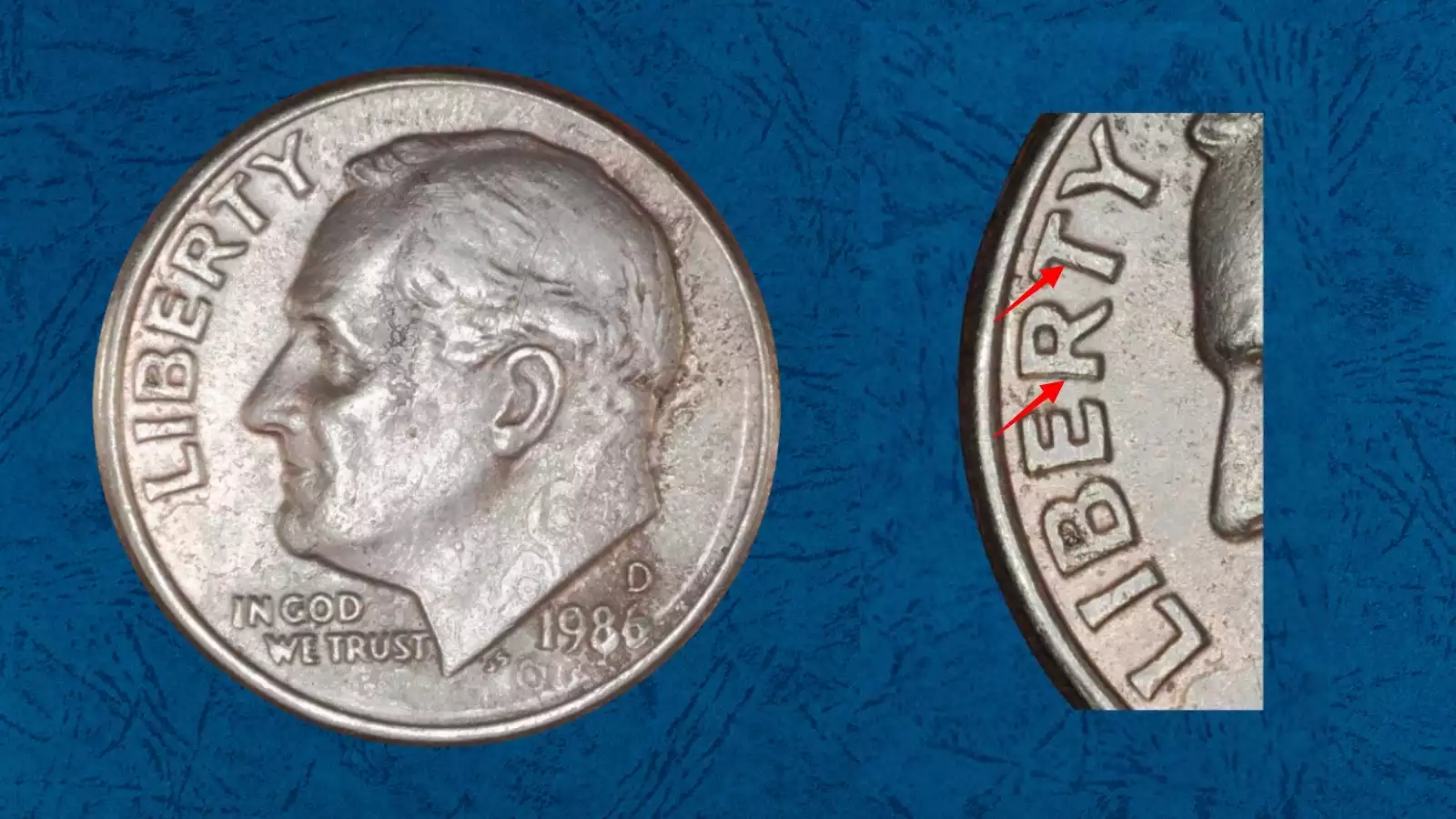
1986 Roosevelt dime obverse showing Doubled Die Obverse error with visible doubling on LIBERTY inscription under magnification

1986 Dime Doubled Die Obverse (DDO)

MOST VALUABLE ERROR $50 – $1,000+

A Doubled Die Obverse occurs during the die-making process when the working hub impresses the design onto the working die at a slightly different angle or rotation on a second or subsequent impression. The result is a die that permanently carries doubled imagery — every coin struck from that die will show the same doubling in the same location, distinguishing DDO from the worthless "machine doubling" caused by post-strike die bounce.

On 1986 Roosevelt dimes, DDO doubling has been documented on the word LIBERTY, the motto IN GOD WE TRUST, and on the individual date digits. The key diagnostic: genuine DDO shows crisp, raised doubling where both images appear at equal height — one image is not sunken below the other. Under a 10× loupe, the doubled element looks like two offset versions of the same letter or number, both standing proud of the coin's surface.

Several 1986-P and 1986-D DDO varieties have been documented by CONECA (Combined Organizations of Numismatic Error Collectors of America) and independent die-variety researchers. Strong, well-attributed DDO examples on gems or near-gem uncirculated 1986 dimes can command significant specialist premiums, with top specimens reaching into the hundreds or thousands among dedicated error collectors.
How to spot it
Under a 10× loupe, check LIBERTY, IN GOD WE TRUST, and the four date digits. Look for crisp shelf-like doubling where two equal-height impressions are visibly offset. Compare to a known machine-doubling example — DDO has raised, equal-height doubling; machine doubling shows a sunken secondary image.
Mint mark
P (Philadelphia) and D (Denver) both documented. S (San Francisco) proof DDO varieties are also known but rare.
Notable
Multiple 1986-P and 1986-D DDO varieties documented by CONECA and listed in the Cherrypickers' Guide. Strong, clearly doubled examples in gem uncirculated grades have sold in specialist auctions for several hundred dollars. Attribution to a specific CONECA variety number significantly increases buyer confidence and realized price.
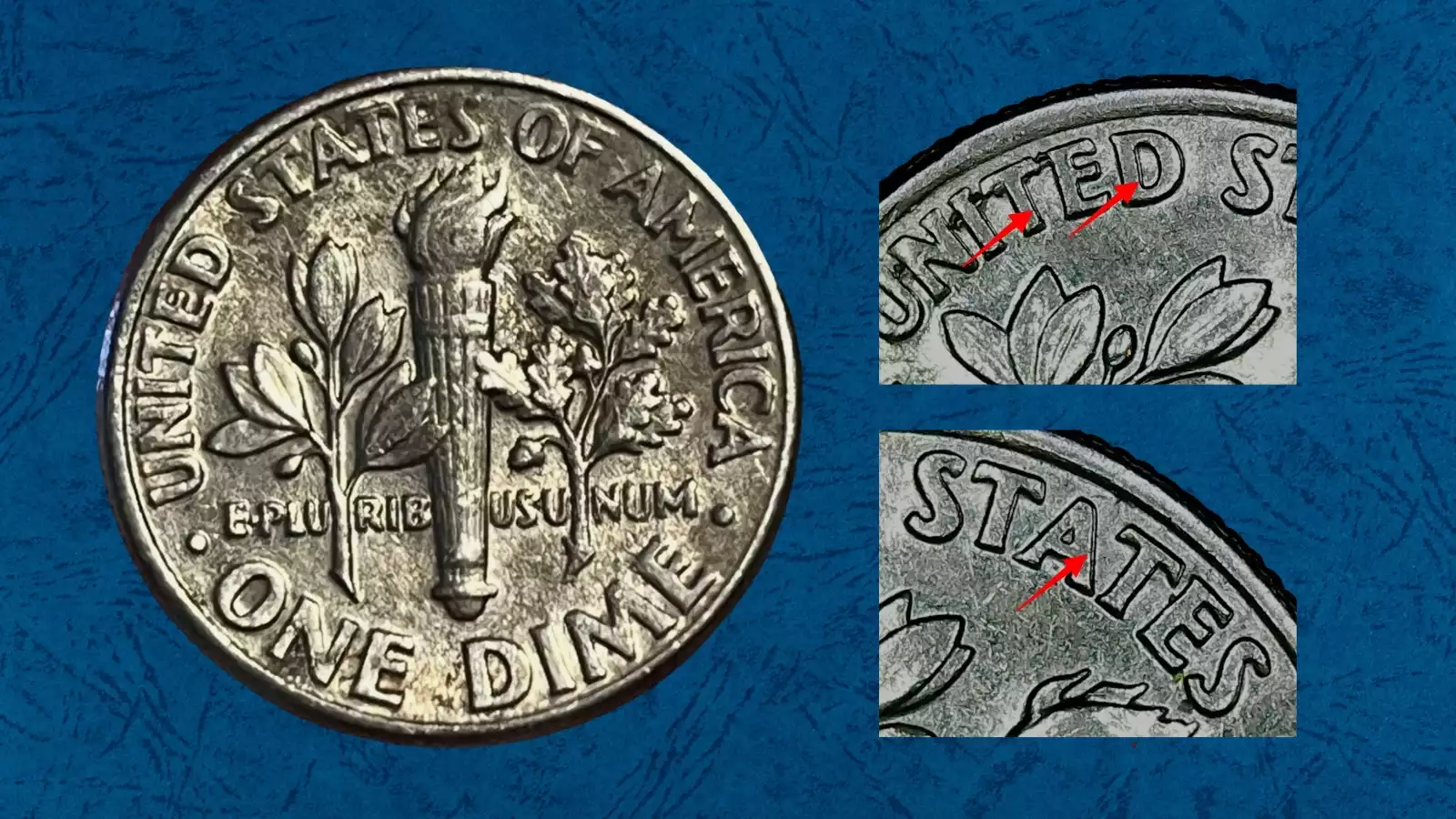
1986 Roosevelt dime reverse showing Doubled Die Reverse error with doubling visible on ONE DIME legend under magnification

1986 Dime Doubled Die Reverse (DDR)

BEST KEPT SECRET $25 – $500+

The Doubled Die Reverse is mechanically identical to the DDO in cause — a working die receiving the hub impression in slightly offset alignment during the die-making hubbing process — but the doubling appears on the reverse design elements rather than the obverse. Because reverse dies are used to strike far more coins before retirement than obverse dies on high-volume modern coinage, DDR examples can be proportionally less common per die than their obverse counterparts.

On 1986 Roosevelt dimes, DDR doubling concentrates on the inscriptions UNITED STATES OF AMERICA, ONE DIME, and E PLURIBUS UNUM on the reverse. In some documented varieties, the torch flame and the surrounding olive and oak branches also exhibit subtle doubling. As with DDO, the diagnostic distinction from worthless machine doubling is the raised, equal-height appearance of both impressions — machine doubling leaves one impression sunken and shelf-like rather than raised.

DDR varieties on 1986 dimes are less heavily catalogued than DDO varieties in public references, making cherrypicking — the practice of finding unattributed varieties in dealer bins — a genuine possibility for collectors who carry a loupe. A well-struck gem uncirculated example with a clearly doubled reverse legend can carry a substantial premium over its unattributed counterpart, especially once formally attributed to a CONECA or PCGS-recognized variety number.

How to spot it
Examine ONE DIME, E PLURIBUS UNUM, and UNITED STATES OF AMERICA under a 10× loupe using raking light. Look for two raised, offset impressions of each letter at equal height. Also check the torch flame tips and the outer edges of the olive and oak branch leaves for secondary images.
Mint mark
P and D issues both documented. S proof DDR varieties are less commonly catalogued but exist.
Notable
DDR varieties for this date are less systematically catalogued than DDO counterparts, creating cherrypicking opportunity in dealer inventory. Formal attribution to a CONECA number — obtained by submitting high-quality photographs to the CONECA die-variety database — is recommended before attempting a premium sale.
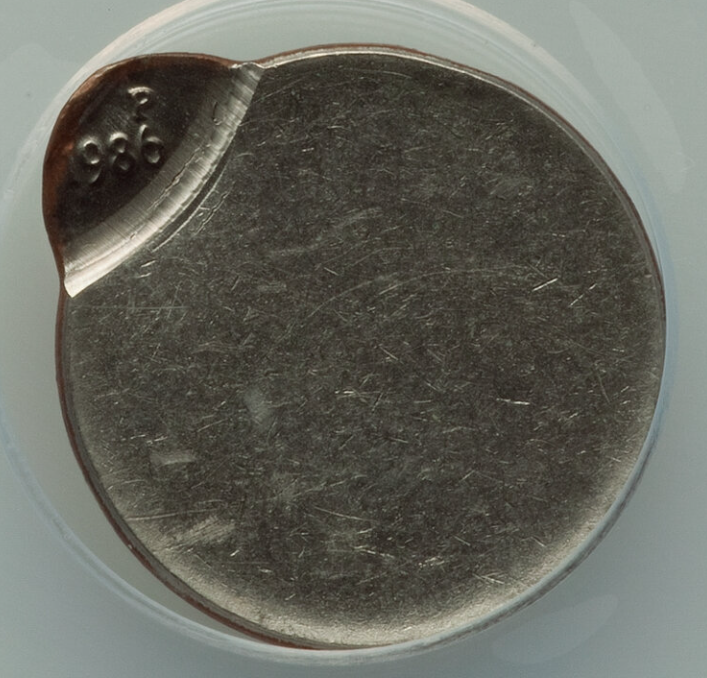
1986 Roosevelt dime showing off-center strike error with design shifted and blank planchet crescent visible

1986 Dime Off-Center Strike

RAREST ERROR TYPE $5 – $1,000+

An off-center strike occurs when a planchet enters the coining chamber misaligned with the dies, so the strike falls partially or completely outside the coin's proper centered position. The result is a coin where part of the design is missing and a crescent or wedge of blank, unstruck planchet metal remains visible. Both the Philadelphia and Denver mints produced off-center 1986 dimes, with neither facility considered more common than the other for this error type.

Value increases substantially with the percentage of misalignment — and, critically, with whether the date is still visible. A 10–20% off-center example showing a narrow blank crescent is relatively common and worth $5–$15. A 50% off-center coin showing roughly half the design against half-blank planchet is dramatically scarcer; one documented 1986-D example struck 50% off-center in MS-66 was consigned to Heritage Auctions in January 2022. The rarest category is 80%+ off-center examples where the date remains visible despite extreme misalignment.

Collectors specifically seek examples where the full date "1986" is legible despite the off-center displacement, because the date is the key attribution element tying the error to this particular year and series. A visually dramatic off-center 1986 dime graded MS-66 or higher by ANACS, PCGS, or NGC can command strong prices in specialized error coin auctions.

How to spot it
Look for a blank, unstruck crescent or wedge of metal on one side of the coin with the design shifted toward the opposite side. Measure the approximate percentage of off-center displacement. Confirm the date "1986" is still fully or partially readable — this is essential for attribution value.
Mint mark
P and D business strikes documented. Philadelphia and Denver examples both occur; neither mint mark is significantly rarer for this error type.
Notable
A 1986-D struck 50% off-center graded MS-66 by ANACS sold at Heritage Auctions in January 2022. A separate 1986-P double-struck, second strike 70% off-center uniface example (AU-58 ANACS) also sold at Heritage Auctions in April 2022, demonstrating strong market appetite for dramatic multi-error specimens from this date.
1986 Roosevelt dime broadstrike error showing expanded diameter beyond normal 17.9mm with smooth non-reeded edge

1986 Dime Broadstrike Error

HIDDEN GEM $5 – $45

A broadstrike occurs when a planchet is struck outside the retaining collar — the hardened steel sleeve that normally constrains the coin's diameter and imparts the reeded edge. Without the collar's restraint, metal flows outward from the strike pressure and the coin expands beyond its standard diameter of 17.90 mm. The result is a coin that is thinner, wider, and has a completely smooth (un-reeded) edge rather than the 118 reeds of a normal dime.

Broadstruck 1986 dimes retain all of the obverse and reverse design elements in their correct relative positions — the strike was properly centered, just unconstrained. The design itself appears "spread" and slightly lower in relief than a normally struck specimen because the metal flowed outward instead of being fully forced upward into the die's recesses. The diagnostic check is straightforward: compare the edge to a normal dime with a loupe — a broadstrike will show a completely smooth, rounded rim edge with no trace of reeding anywhere around the circumference.

Broadstrikes on clad dimes are moderately common in the error coin market because collar malfunctions occurred across many date and mint combinations. The 1986 examples are collected as date-specific pieces within the Roosevelt dime broadstrike type, valued for both their error characteristics and the date identification. Clean, problem-free examples with intact surfaces trade for $5–$45, with price driven by the degree of diameter expansion and the sharpness of the remaining design detail.

How to spot it
Hold the coin edge-on and rotate it while looking with a 10× loupe. A normal 1986 dime has 118 uniform reeds around the entire circumference. A broadstrike will show a completely smooth, rounded edge with zero reeding visible anywhere. Measure the diameter — it should exceed the standard 17.90 mm by a measurable amount.
Mint mark
P (Philadelphia) and D (Denver) both documented. Broadstrike errors are not known for the S proof since proof strikes used a different collar mechanism.
Notable
Broadstruck 1986 dimes value in the $5–$45 range depending on the degree of expansion and surface quality. Dramatic examples with maximum diameter expansion and strong design detail command the highest premiums within the type. ANACS, ICG, and the major grading services all recognize broadstrikes as legitimate mint errors and will slab them accordingly.

Found one of these errors on your coin?

Put the mint mark, condition, and error type into the calculator above for an instant estimate of what it's worth today.

Get My Error Value →

1986 Roosevelt Dime Mintage & Survival Data

Group of 1986 Roosevelt dimes from Philadelphia and Denver mints showing the scale of production
Mint / Variety Mintage Type Survival Estimate
Philadelphia (P) 682,649,693 Business strike Unknown — very high
Denver (D) 473,326,970 Business strike Unknown — very high
San Francisco (S) ~3,010,497 Proof only ~2,573,974 (≈85.5%)
Total All Mints ~1,158,987,160
Composition specs: The 1986 Roosevelt dime is 75% copper and 25% nickel clad over a pure copper core — the standard clad composition used since 1965. Weight: 2.27 g. Diameter: 17.90 mm. Edge: reeded (118 reeds). Designer: John R. Sinnock (initials "JRS" below Roosevelt's truncated neck). The Philadelphia Mint added the "P" mint mark to dimes starting in 1980, which is why pre-1980 Philadelphia dimes have no mint mark while post-1980 issues show "P."

Despite the massive combined mintage of over 1.15 billion business strikes, gem-quality uncirculated examples without wear or contact damage are genuinely scarce. The speculative roll-saving market that preserved earlier Roosevelt dimes largely collapsed after 1964, leaving post-clad dimes with fewer saved examples at the top grades than their mintage numbers suggest. The San Francisco proof survival rate of approximately 85.5% reflects intentional collector storage rather than circulation.

How to Grade Your 1986 Roosevelt Dime

Accurate grading is essential because the difference between MS-65 ($6.50) and MS-67 FB ($1,998) on this coin is enormous. Use the conditions below as a guide before submitting to PCGS or NGC.

Grading strip showing four 1986 Roosevelt dimes representing Worn, Circulated, About Uncirculated, and Gem Uncirculated conditions

Worn (G-4 to F-12)

Major design elements — Roosevelt's hair, cheek, and jawline — show heavy flatness. The torch detail on the reverse is largely gone. Only the outline of the design remains clear.

Fine lines in Roosevelt's hair above the ear are merged into flat areas. Torch bands are indistinct regardless of original strike quality.

Value: $0.10 – $0.35 (essentially face value)

Circulated (VF-20 to AU-58)

VF coins retain moderate detail — hair above the ear shows some separation, lettering is sharp. By EF-40, all major details are present but the cheek below the eye shows light wear.

AU-58 examples have only the faintest friction on the highest points: Roosevelt's cheek and the top of the torch flame. Original mint luster may still show in the protected fields.

Value: $0.15 – $0.50

Uncirculated (MS-60 to MS-65)

No wear anywhere. Original cartwheel luster rotates across all surfaces under a single moving light source. MS-60–63 may show significant contact marks from bag handling. MS-65 shows only a few small, scattered marks.

At MS-65, strike quality begins to matter significantly. Inspecting the torch bands for Full Bands potential is worthwhile at this grade level and above.

Value: $0.75 – $10 (standard); $18 – $45 (Full Bands)

Gem (MS-66 to MS-68)

Near-perfect surfaces with minimal contact marks. Luster is strong and full. At MS-66 and above, the torch bands become the primary discriminating factor: an MS-67 without FB is worth roughly $25; the same coin with FB certification is worth $100–$1,998.

Even a tiny mark crossing the horizontal torch bands can prevent FB designation at this grade level. Surface preservation and strike quality must both be exceptional.

Value: $10 – $150 (standard); $100 – $1,998+ (Full Bands)

Pro tip — strike designation matters more than grade here: On the 1986-P specifically, PCGS has noted that "any example displaying Full Bands characteristics is scarce and very difficult to find in any condition." When examining your coin, spend more time checking the torch bands than counting contact marks — a well-struck MS-66 FB is worth far more than a nearly perfect MS-68 without the designation.

🔬 CoinHix lets you cross-check your condition assessment against a database of graded examples — snap a photo and compare your coin to certified specimens before committing to a grading submission — a coin identifier and value app.

Where to Sell Your Valuable 1986 Roosevelt Dime

The right venue depends on whether you have a common circulated example, an uncirculated gem, or a Full Bands / error coin with real collector value.

🏆 Heritage Auctions

The proven venue for top-end 1986 dimes. Both the $1,998 (1986-P MS-67 FB) and $1,320 (1986-D MS-67 FB) records were achieved at Heritage. If your coin is MS-66+ or has Full Bands designation, Heritage gives it the greatest collector audience and best chance at a competitive price.

Minimum consignment thresholds apply — confirm your coin qualifies before submitting. PCGS or NGC certification is expected for any meaningful lot.

📦 eBay

Ideal for mid-range uncirculated examples (MS-60 to MS-65), error coins priced under $300, and 1986-S proof sets. Check the recently sold prices for 1986 Roosevelt dimes listed on eBay to see current market comps before you price your listing. Slabbed PCGS/NGC coins consistently sell for more than raw coins at equivalent grades.

Always use completed listings (sold, not active) when researching your selling price — active listings are asking prices, not realized prices.

🏪 Local Coin Shop (LCS)

Best for quick liquidity on circulated or low-grade uncirculated examples where auction fees would exceed potential profit. Dealers typically pay 50–70% of retail for common date clad dimes.

A local dealer can also give a free opinion on whether your coin looks like a genuine FB candidate worth submitting for grading — saving you a potentially wasteful grading fee on a coin that won't earn the designation.

💬 Reddit r/Coins4Sale

Strong peer-to-peer market for attributable error coins (DDO, DDR, off-center) at fair prices without auction-house commission. The community has active error collectors who will pay honest market rates.

Post clear, well-lit macro photographs of the specific error detail, state the grade estimate or certification, and price the coin using eBay completed sales as your reference. Transactions use PayPal Goods & Services for buyer/seller protection.

💡 Get it graded first: If your 1986 dime appears to grade MS-66 or higher, or if the torch bands look like they might qualify for Full Bands, professional certification from PCGS or NGC is strongly recommended before selling. A graded, slabbed 1986-P FB at MS-67 could be worth $500–$2,000; the same coin raw might sell for $50–$100 to a skeptical buyer. Grading fees are a sound investment when the potential upside is this large.

Frequently Asked Questions — 1986 Dime Value

How much is a 1986 dime worth?
Most circulated 1986 Roosevelt dimes are worth face value — about 10 cents. In uncirculated condition (MS-65), expect $6–$11. The real exceptions are Full Bands (FB) examples: the 1986-P MS67FB sold for $1,998 at Heritage Auctions in December 2015, and the 1986-D MS67FB realized $1,320 at Heritage Auctions in October 2020. Proof versions (1986-S DCAM) peak around $95 for top grades.
What is the Full Bands designation on a 1986 dime?
Full Bands (FB) is a strike quality designation awarded by PCGS to Roosevelt dimes that show complete, unbroken separation of the horizontal bands on the reverse torch. NGC uses the equivalent term Full Torch (FT) with slightly stricter standards. A coin can grade MS-67 yet fail to earn FB if a single contact mark crosses the bands. The designation dramatically multiplies value — a 1986-P MS67FB is worth roughly 15 times more than a standard 1986-P MS67 without it.
What is the difference between the 1986-P and 1986-D dime?
The 1986-P (Philadelphia) had a mintage of 682,649,693 and the 1986-D (Denver) produced 473,326,970 — about 209 million fewer. In circulated and lower mint-state grades both are worth the same near face value. At the top of the market, however, the 1986-P Full Bands is the rarer and more valuable issue, with no published retail pricing for multiple FB grades, indicating very few known examples.
Is the 1986-S proof dime valuable?
The 1986-S proof dime had a mintage of about 3,010,497. Most PR-65 to PR-69 DCAM examples are common and trade for $3–$20. Perfect PR-70 DCAM specimens can reach up to $95. There is a 'PR-70 cliff' effect — the gap from PR-69 to PR-70 in value is steep, but overall proof values are modest because supply easily meets collector demand.
What 1986 dime errors should I look for?
The most sought-after errors on 1986 dimes include: Doubled Die Obverse (DDO) with doubling on LIBERTY, IN GOD WE TRUST, or the date; Doubled Die Reverse (DDR) with doubling on ONE DIME or E PLURIBUS UNUM; Off-Center strikes (especially 50%+ off-center with the date visible); Broadstrike errors; and Clipped Planchet errors. Major multi-error coins — like a double-struck 70% off-center uniface example — have sold at Heritage Auctions.
How do I find the mint mark on a 1986 dime?
The mint mark on a 1986 Roosevelt dime appears on the obverse (front) of the coin, directly above the date '1986.' Philadelphia dimes show a small 'P,' Denver dimes show a small 'D,' and San Francisco proof dimes show a small 'S.' Use a 5× or 10× loupe to see the mint mark clearly, as it is quite small. Philadelphia began using the 'P' mint mark on dimes starting in 1980.
What does a 1986 dime weigh and what is it made of?
The 1986 Roosevelt dime weighs 2.27 grams and measures 17.90 millimeters in diameter. It is composed of 75% copper and 25% nickel clad over a pure copper core — a clad composition used on all Roosevelt dimes since 1965. The reeded edge features 118 reeds. The designer was John R. Sinnock, whose 'JRS' initials appear below Roosevelt's truncated neck on the obverse.
Should I get my 1986 dime professionally graded?
Professional grading (PCGS or NGC) only makes financial sense for 1986 dimes that appear to be MS-66 or higher in grade, show potential Full Bands strike quality on the torch bands, or have a dramatic mint error. Grading fees typically start around $30–$50 per coin, so submitting a coin worth only a few dollars in uncirculated condition is not economical. Have a knowledgeable dealer or coin club member evaluate the coin before submitting.
How many 1986 dimes were made in total?
A combined total of roughly 1.159 billion 1986 Roosevelt dimes were produced across three mints: Philadelphia struck 682,649,693; Denver struck 473,326,970; and San Francisco produced approximately 3,010,497 proof coins for collector sets. The enormous business-strike mintage makes circulated examples extremely common and worth only face value in most grades.
What is the all-time auction record for a 1986 dime?
The all-time auction record for a 1986 dime is $1,998, achieved by a 1986-P graded MS-67 Full Bands (FB) by PCGS, sold at Heritage Auctions on December 3, 2015. The 1986-D Full Bands record stands at $1,320, set at Heritage Auctions on October 21, 2020. Both sales confirm that Full Bands strike quality is the single biggest value driver for this otherwise common clad coin.

Ready to find out what your 1986 dime is worth?

It takes under 30 seconds. Select your mint mark, condition, and any errors — get your instant estimate now.

Check My 1986 Dime Value →